

Sell This Fall or Wait for Spring? What the Numbers Say in Santa Cruz and Monterey County

Photo: Armaan Sharma / Unsplash
Mortgage rates are holding at 7.40 percent. Here is what the newest numbers say about listing now or waiting for spring, and two real conversations I had with sellers recently.
Mortgage rates are holding at 7.40 percent. Here is what the newest numbers say about listing now or waiting for spring, and two real conversations I had with sellers recently.
Two homeowners sat down with me recently, and both had a number in mind.
The first owns a home in the mountains. His first question is one I hear more and more: have my property values gone down? He was hoping for $1.5 million. The second owns a property made of three lots. He wanted to split one lot off and sell it, and he was hoping that one lot would bring $1 million.
The market gave us different numbers. I will tell you how both conversations went, because they say more about selling this fall than any headline.
But first, the question I hear most this time of year: should I list now, or wait for spring? Here is what the numbers say for our two counties right now.
Where our market really is
The newest county numbers are for August. September reports come out later this month.
Santa Cruz County. The median single family home sold for $1,370,000 in August, down 1.9 percent from a year earlier, according to the California Association of Realtors. Fewer homes changed hands: 111 single family sales, 13 percent fewer than last August, per MLSListings. But the homes that sold did it fast. The typical one sold in 14 days, at 100 percent of its asking price.
Monterey County. More homes are selling, at softer prices. In August, 167 single family homes sold, 11 percent more than a year ago. The typical one took 27 days and sold for 98 percent of asking. C.A.R. puts the August median at $911,000, down 16.2 percent from a year earlier. Read that one with care: a single month can swing a lot, and MLSListings has the same month at $940,000. Either way, buyers in Monterey County have room to negotiate right now.
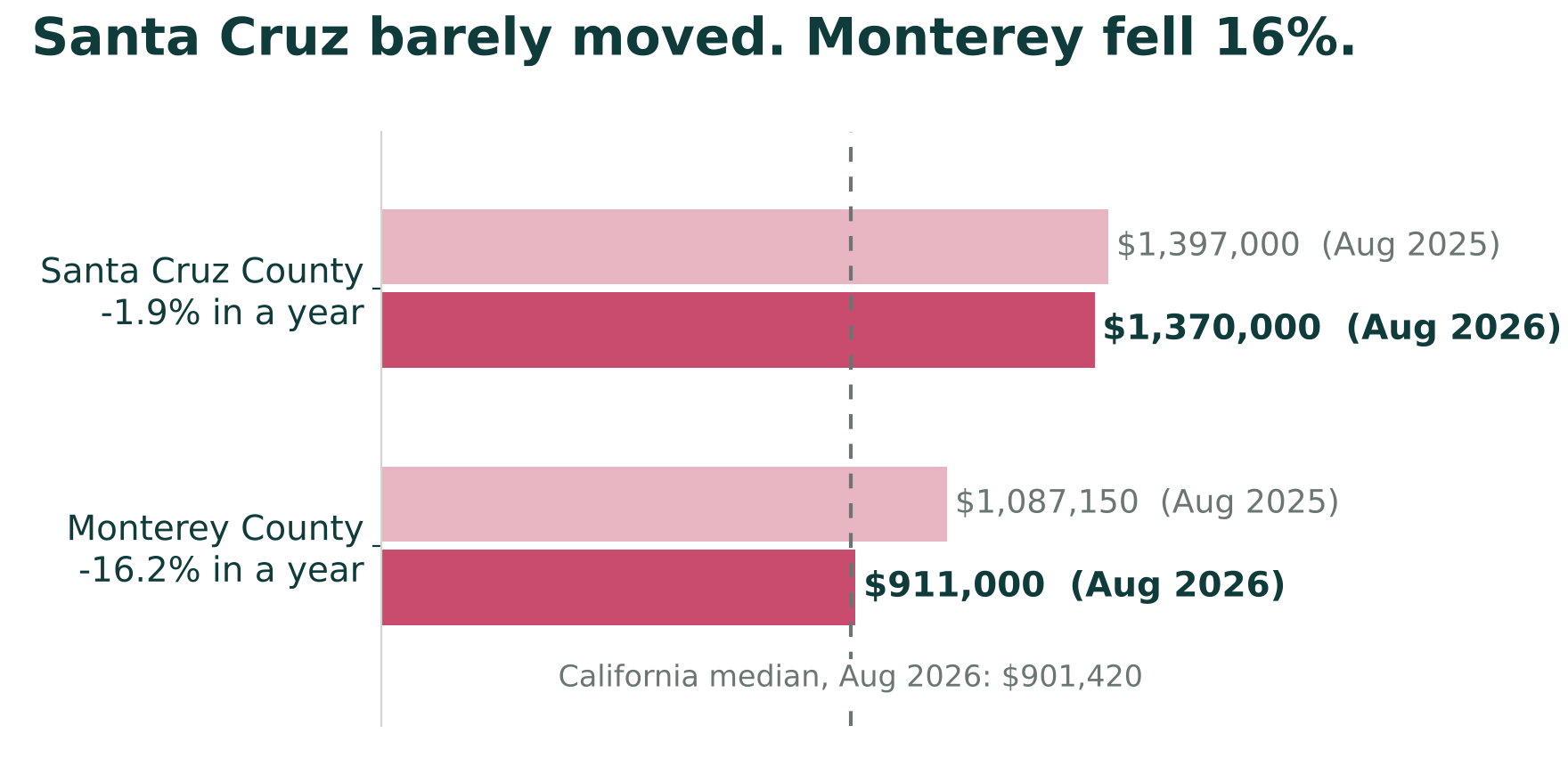
Source: California Association of Realtors, August 2026 sales and price report, released September 16, 2026.
Statewide, the median was essentially flat from a year ago.
Two markets in one county
Here is the part the medians hide. Right now about 440 single family homes are for sale in Santa Cruz County. The typical one has been on the market for 63 days, and 43 percent of them have already cut their price, according to Altos Research data for the week of October 7.
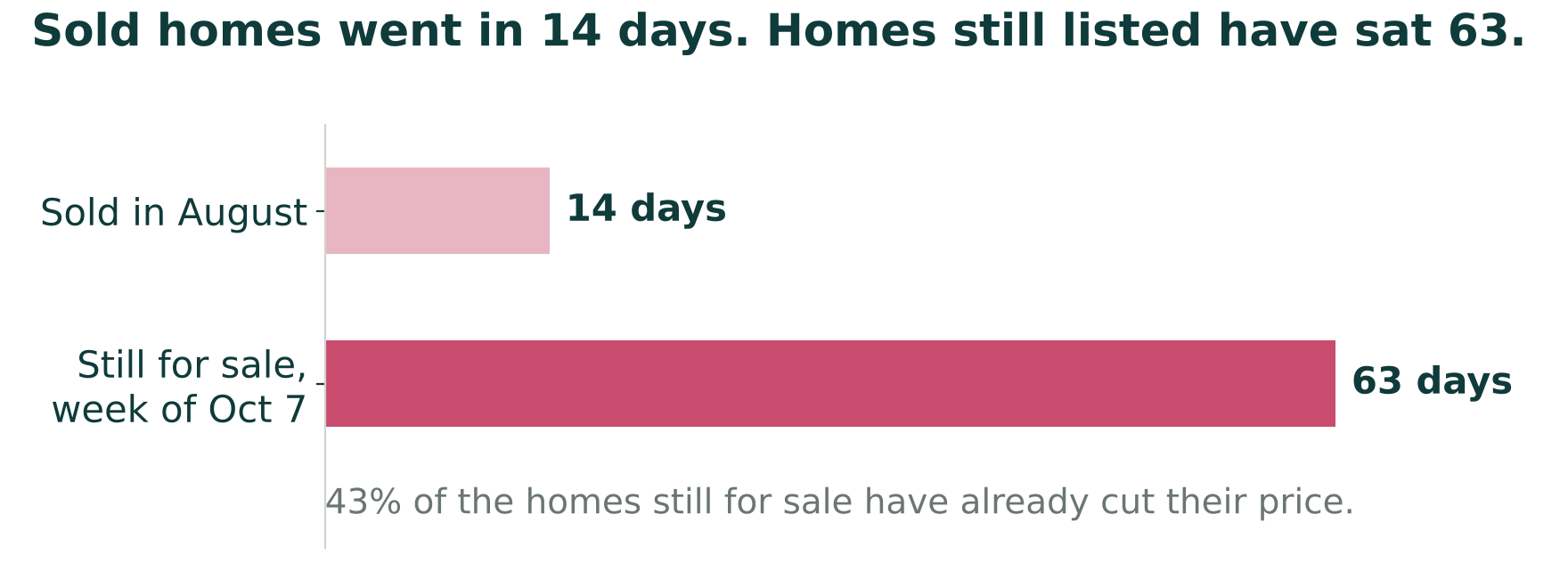
Sources: MLSListings, August 2026 (sold); Altos Research, week of October 7, 2026 (still for sale).
So in the same county, some homes sell in two weeks at full price while others sit for two months and get reduced. The difference is rarely the season. It is price and presentation, and the two conversations I had recently show why.
Two sellers, two hard conversations
The mountain home. The first seller asked me straight out: have my property values gone down? He was expecting about $1.5 million. After I went through the comps with him, the highest price I could honestly give him was $1.2 million.
Here is where that number came from. The three closest sales to his home were mountain houses built in the late 1970s, about the same size, on lots of a little more than an acre. They sold for $925,000, $1,130,000 and $1,199,000. The automated valuation in the same comp report landed at about $1.14 million.
So it was not about a flaw in his house, and it was not about the season. Even with every permit in place, there were simply no sales anywhere near $1.5 million to support that price. A price has to stand on what actually sold.
Other things that can move a mountain price. His home was not priced down for these, but plenty of homes in our hills deal with them, and buyers notice:
- Unpermitted work. Appraisers often leave unpermitted square footage out of a home’s official living area, and many lenders will not count it. Buyers do their own math: what will it cost to permit it after the fact, or to take it out? They subtract that number, and a little more for the risk. In California, sellers also have to disclose known work done without permits.
- A steep driveway. It shrinks the pool of buyers. Some do not want to drive it in a winter storm. Some have a parent moving in, or picture backing out with kids in the car.
- A busy road. Traffic noise and getting in and out safely matter to buyers, and the comps for homes like that usually show it.
If your home has any of these, it pays to know what they are worth before you set a price.
How to value unpermitted work. If your home has space or work that was never permitted, this is how I would approach it:
- Find out what is on record. Ask the county planning department for your property’s permit history, so you and your buyers are working from the same facts. Cost: usually just your time.
- Get a real number for fixing it. Ask a licensed contractor what it would take to permit the work after the fact (sometimes called an as-built permit), or to remove it. A written estimate beats a buyer’s worst guess. Cost: many contractors give estimates for free; permit fees depend on the project.
- Price it the way the market will. Value the permitted home on the comps. Give the unpermitted space some value, but less than permitted space, after subtracting what a buyer would spend to make it legal. Then disclose it clearly.
The triple lot. The second seller owns a property made of three lots. He wanted to split one lot off and sell it on its own, and he expected that lot to carry the value of the whole property, about $1 million.
Here is the catch. When you partition a lot, the entitlements to water, sewer and electricity do not come with the new piece. A buyer would have to secure them again, and that can take a long time, cost a lot, or not be possible at all. Buyers know that, and they price it in. The comps for a lot like his pointed closer to $300,000.
If you are thinking about splitting a property, talk to the county planning department and your water and sewer providers before you do anything else, so you know exactly what the new lot would and would not come with.
What I told both of them. I hope you can get that price one day, but the numbers I see, and the ones I am showing you, are not there today.
Watch out for an agent who “buys” your listing. I also gave them both a warning. Some agents will tell you the number you want to hear just to win your listing. In our business, that is called buying the listing. The home goes on the market too high and sits. Then the price gets cut, and cut again, as the agent chases the market down. Meanwhile you have spent months and the best part of your season, and buyers start to wonder what is wrong with the house. Remember that 43 percent of the homes for sale in Santa Cruz County have already cut their price.
Sadly, it is a strategy, and it feels like a bait and switch. I will not participate in it. I would rather give you a number you do not love today than a number that costs you your season.
Rates went the wrong way this fall
On October 15 the average 30 year fixed rate was 7.40 percent for the second week in a row, according to Freddie Mac. That is up from 6.66 percent at the end of August and 6.30 percent a year ago. The Federal Reserve raised rates on September 16 and meets again October 27 and 28.
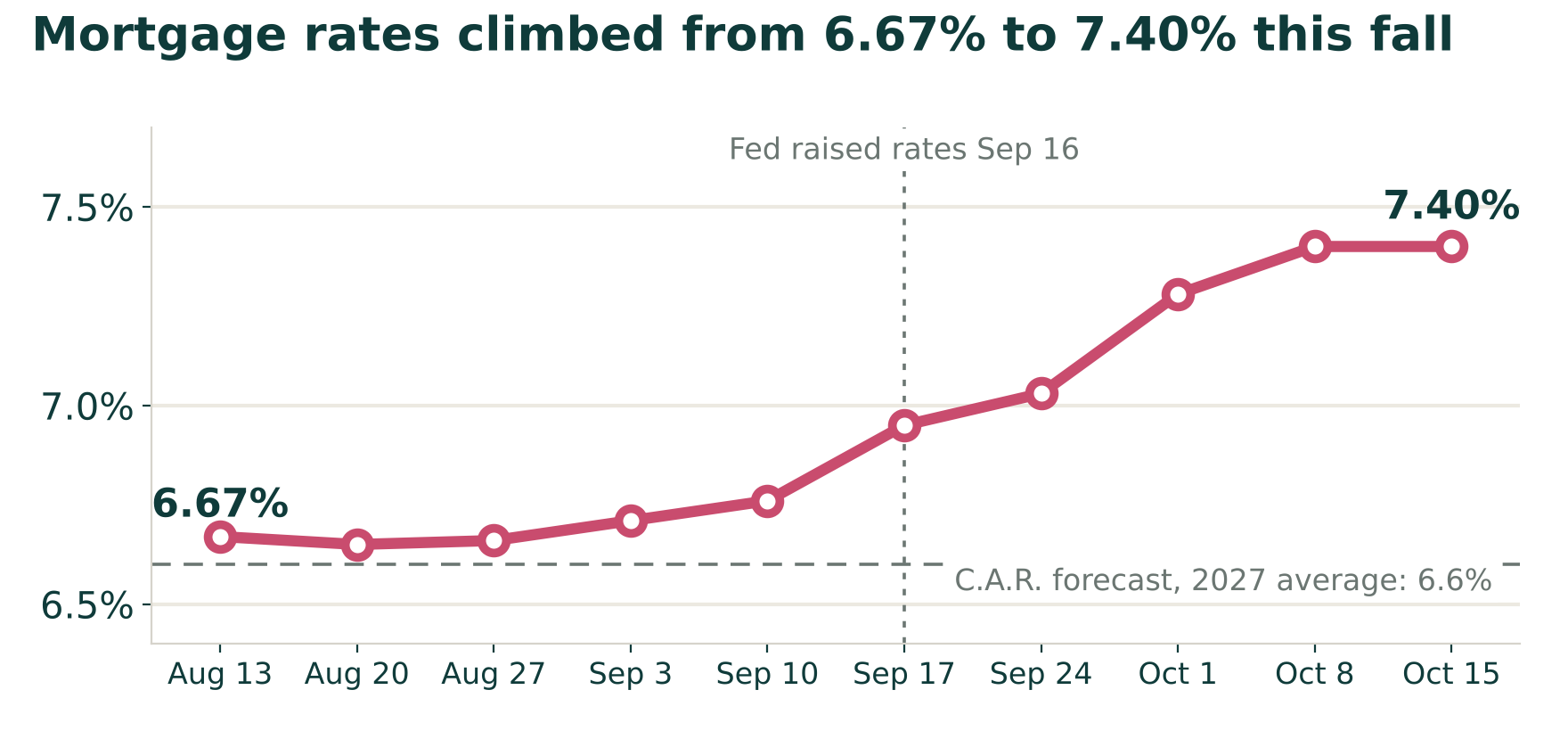
Sources: Freddie Mac Primary Mortgage Market Survey, August 13 to October 15, 2026; California Association of Realtors 2027 forecast, October 7, 2026.
Will spring be better? Maybe a little. On October 7 the California Association of Realtors released its forecast for 2027. It expects rates to average about 6.6 percent next year, and the statewide median price to rise just 1.4 percent. That is a forecast, not a promise. And notice what it does not predict: a return to the five percent rates so many people are still waiting for.
If you own a rental: hold, and line up your equity first
Not every owner I talk to is choosing between fall and spring. Many investors are choosing not to sell at all. Their rentals have tenants and cash flow, and with appreciation cooling, insurance climbing and borrowing costing more, the math on selling is less forgiving than it was a few years ago.
If that is you, one strategy is worth a conversation with a lender now: a HELOC on the investment property itself, a line of credit against the rental’s equity. The lender sets the size of the line from an appraisal, so opening it while values are still close to their peak can mean a bigger line than you might qualify for after prices cool. Left untouched, it becomes your “dry powder”: money you can reach quickly when a good deal, a down payment or a big repair comes along.
One honest caution: a credit line is not a guarantee. If home values drop sharply, federal rules let a lender freeze or lower an open line. Treat it as a backup plan, not the plan.
How a rental HELOC compares with one on your own home
| HELOC on your home | HELOC on a rental | |
|---|---|---|
| Maximum loan-to-value | Up to 90% | Up to 80%, and many lenders stop at 70% to 75% |
| Credit score | Usually 620 or higher | Usually 700 to 720 or higher |
| Cash reserves | Often not required | 6 months or more, plus proof of tenants |
| Debt-to-income | 43% or less preferred | 40% to 50% |
| Interest rate | The lender’s standard HELOC rate | Usually higher |
Sources: NerdWallet, HousingWire.
Why investors like it
- A cushion for a reset. Open the line while values are high. If prices fall and opportunities show up, you can draw on it for a down payment, a renovation or a discounted purchase instead of paying hard-money rates.
- Dry powder that costs little to keep. You pay interest only on what you draw. Ask about annual fees and closing costs before you sign.
- A possible tax advantage. When the money goes into improving that same rental, the interest may be deductible as a rental expense. Ask your CPA before you count on it.
Where to find one. Not every bank writes HELOCs on rentals, and many big banks don’t. Ask local credit unions, regional portfolio lenders or a mortgage broker. A few national lenders advertise them: NerdWallet lists Rate among them, and Deephaven Mortgage, which works through brokers, offers one up to 75% of the property’s value with a 700 minimum credit score.
Where to start
If you are on the fence, start with your own numbers: not the headlines, and not the number someone gives you to win your listing. I can pull what sold on your street this year and what is sitting right now, and we can look at it together, with no pressure and no deadline. Fall or spring, the goal is the same: you should not leave money on the table, and you should not lose a season chasing a price that is not there.
I am a REALTOR, not a lender, an insurance broker, a contractor, a land use planner or a tax professional, so please take those pieces to the right person.
And if you want to talk through your situation, just ask.
Sources
- C.A.R., August 2026 sales and price report
- C.A.R., 2027 housing forecast
- MLSListings, single family county summary, August 2026
- Altos Research, Santa Cruz County single family, week of October 7
- Freddie Mac Primary Mortgage Market Survey and weekly history
- Federal Reserve, FOMC meeting calendar
- NerdWallet, Can you get a HELOC on an investment property? (updated February 25, 2026)
- HousingWire, Deephaven Mortgage launches Equity Advantage HELOC
More in Market Updates & Forecasts

2023 Real Estate Market Outlook (And What It Means for You)
After a wild ride in 2020 to 2022, what can buyers, sellers, and homeowners expect from the real estate market in 2023? Here's our outlook.

A Return to 'Normal'? The State of Real Estate in 2022
After two years of a frenzied real estate market driven by pandemic trends, many buyers and sellers are wondering: are things getting back to normal? The short answer…

Higher Rates and Short Supply: The State of Real Estate in 2022
Midway through 2022, the real estate market is adjusting to a new reality: mortgage rates have surged and inventory remains stubbornly low. Here's what's happening and what it…