

Waiting for Rates to Drop? Nine Things You Can Control Instead.

Photo: Vitaly Gariev / Unsplash
The Fed raised rates on September 16 and mortgage rates just hit a one year high. Here are nine ways Central Coast homeowners can lower a monthly payment without waiting on anybody.
Update, September 23: On September 16 the Federal Reserve raised rates for the first time since 2023. I have updated the numbers below. The nine steps have not changed. If anything, they matter more now.
I have had four conversations in the last two weeks that were essentially the same conversation. Someone is thinking about selling, or thinking about buying, and they tell me they are going to wait a little longer. Wait for rates to come down. Wait for things to settle.
I understand it completely. And I want to say something gently, because I think a lot of us have been waiting for something that is not on its way.
What most people have not heard yet
Here is what has not made it into most kitchen table conversations: the Fed did not cut rates once in 2026. It held steady at every meeting through the summer, and back in July three voting members actually dissented because they wanted to raise them. Then on September 16 it did raise them, for the first time since 2023, to a range of 3.75 to 4 percent. The vote was unanimous, and most Fed officials expect one more increase before the end of the year.
And here is the part that stings, because we were so close. In late February the 30 year fixed dipped to 5.98 percent, the lowest since 2022, and most forecasts had us finishing this year right around six percent. That was the plan a lot of families were quietly counting on.
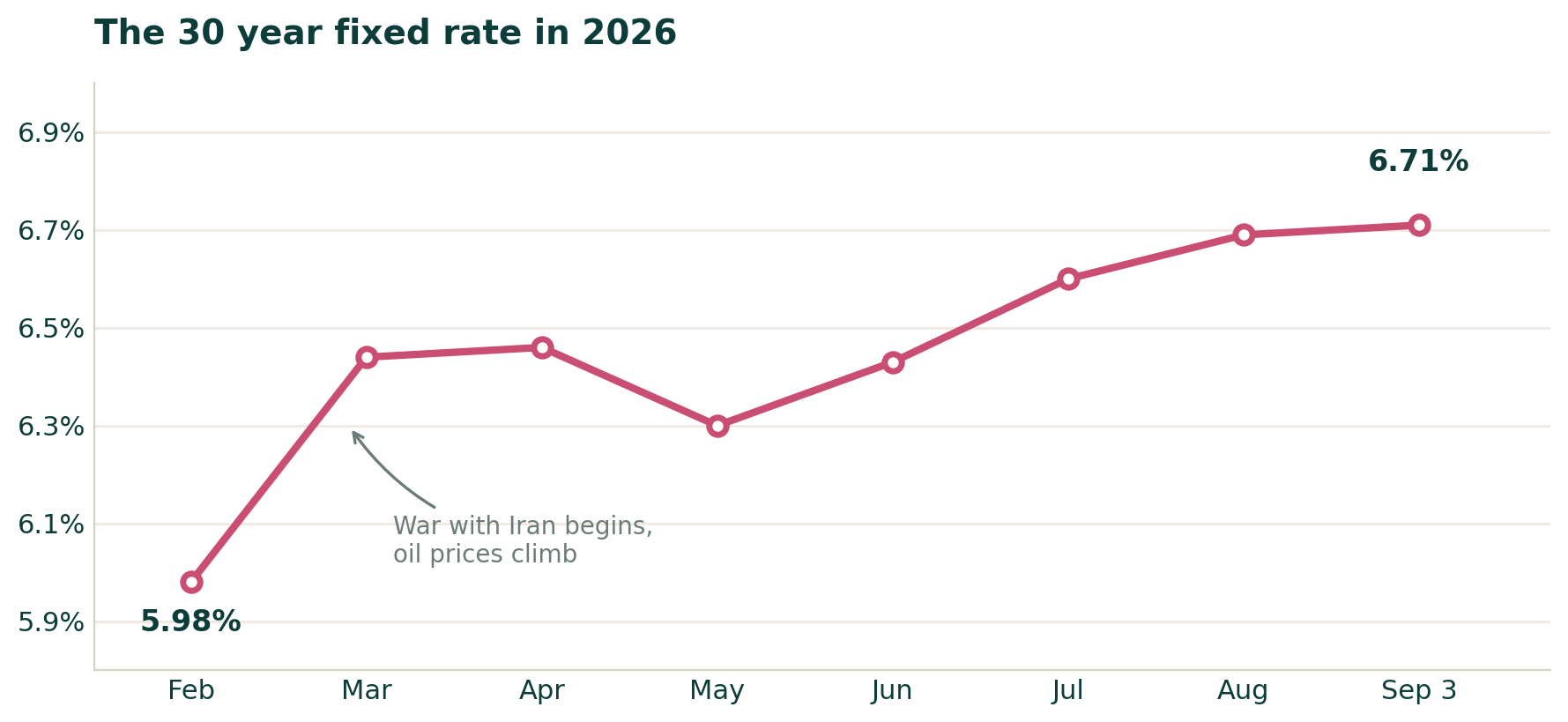
The 30 year fixed rate in 2026, through early September. Source: Freddie Mac.
Then the war with Iran began on February 28, and oil went with it. Crude has been pushing toward one hundred dollars a barrel, and when energy costs climb, inflation expectations climb too, and the bond market reprices everything. Mortgage rates followed. Freddie Mac had us at 6.71 percent on September 3, and at 6.95 percent on September 17, the highest in a year. That is almost a full point above the February low.
I am not telling you this to be discouraging. I am telling you because the relief we were waiting on did not simply get delayed. It got interrupted by something almost nobody had on their 2026 bingo card.
The part nobody explains
Whatever the Fed does, your mortgage rate does not automatically follow it. I say that kindly, because it is genuinely confusing and almost nobody spells it out.
The Fed sets what banks charge each other overnight. That moves credit cards and home equity lines almost immediately. But nobody lends money for thirty years based on what banks charge each other tonight. A 30 year mortgage tracks the 10 year Treasury yield, which moves on inflation expectations and on where investors think the economy is heading. Two different clocks. In the fall of 2024 the Fed cut and mortgage rates went up anyway.
So let me spend the rest of this on the things that are actually in your hands, because there are more of them than most people realize and almost none of them depend on the Fed.

Photo: Vitaly Gariev / Unsplash
First, if you bought with a buydown
Seller paid rate buydowns became one of the most common tools in American real estate over the last few years. Nearly half of all U.S. home sales now include some kind of seller concession, and buydowns are a big piece of that.
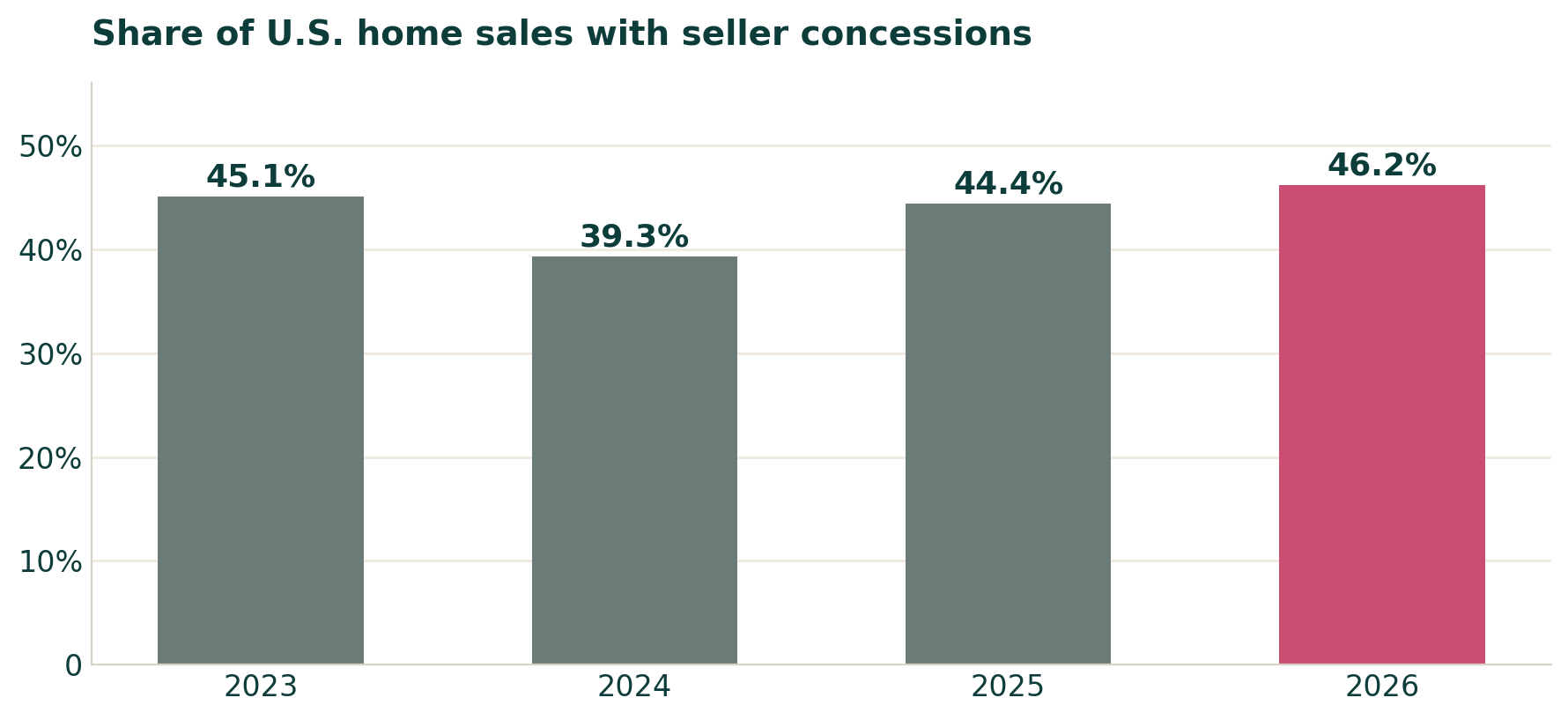
First quarter figures for 2023 through 2025, and the three months ending May 31 for 2026. Source: Redfin.
But look at where we live before you assume this applies to you. In the San Jose area only 5.9 percent of sales included concessions this spring, and in San Francisco 14.9 percent, against a national average of 46.2 percent and 75.5 percent in Nashville. The buydown wave largely passed over coastal California, where inventory stayed tight and sellers rarely had to offer them. So if you have a buydown here, you most likely bought new construction, or bought inland, or negotiated hard.
Either way, watch the calendar. A 3-2-1 buydown lowers your rate three percent the first year, two the second, one the third. In year four you pay the full note rate, and a payment can climb from around two thousand dollars to around twenty eight hundred. Most people who took one were told they would refinance before it expired. That plan assumed rates would fall. Do not wait until the month it changes.
If you have a conventional loan
1. Ask about recasting.
If you can put a lump sum toward principal, many lenders will re-amortize your loan and permanently lower your payment. No refinance, no new rate, usually a modest fee. This is the most overlooked option on this entire list.
2. Drop your PMI.
Specific to conventional loans. Once you reach twenty percent equity, private mortgage insurance can come off, and between your payments and the appreciation we have had, you may already be there without realizing it.
3. Pay extra toward principal now.
Every dollar you pay down before a rate step up is a dollar the higher rate is no longer calculated against. And ask what happens to money still sitting in your buydown escrow if you refinance or pay off early. In most cases it goes toward your payoff.
If you have an FHA loan
FHA works differently, and this is where I see the most confusion.
Your mortgage insurance does not come off at twenty percent equity. On most FHA loans written after 2013 with less than ten percent down, the annual premium stays for the life of the loan. With ten percent or more down, it drops off after eleven years.
And an FHA Streamline Refinance does not remove it. The Streamline replaces one FHA loan with another and the insurance clock starts over. What it does do is lower your rate with very little paperwork, usually no appraisal and often no income verification, as long as you have six months of on time payments. Useful, just not for the reason people assume.
The only real exit is refinancing into a conventional loan, which generally means twenty percent equity and a credit score around 620. Given how much Central Coast homes have appreciated, more FHA borrowers qualify than realize it. And if you refinance into another FHA loan within three years of the original, you may get a partial refund of the upfront premium you paid. The refund shrinks monthly, so timing matters.

Photo: Armaan Sharma / Unsplash
Insurance, and the honest difference between flood and fire
Insurance has become one of the biggest line items in a Central Coast payment, and I want to be careful here, because flood and fire work completely differently and people assume they are the same.
4. Flood: you can actually get removed from the zone.
FEMA has a formal process for this called a Letter of Map Amendment, and it exists precisely because maps drawn at a large scale sometimes sweep in properties sitting on naturally high ground. If the lowest ground touching your house is at or above the base flood elevation, FEMA can amend the map for your property specifically. Your neighbors stay in the zone. You come out.
The process: look up your address at the FEMA Map Service Center, hire a licensed land surveyor for an Elevation Certificate, then submit through FEMA’s online Letter of Map Change tool. FEMA charges no fee to review a standard LOMA, so your real cost is the surveyor. Get two or three quotes. FEMA normally issues a determination within sixty days, and surveyors registered for the electronic version can sometimes get an answer in minutes. Services will handle the paperwork for roughly three to six hundred dollars, but they do not replace the surveyor.
If it is approved, send it to your lender, ask them to remove the flood insurance requirement, then cancel the policy and request a refund of the unused premium. For a family paying flood insurance on a house that never needed it, this is one of the highest return phone calls available.
5. Fire: there is no equivalent, and anyone who tells you otherwise is guessing.
California fire hazard severity zones are drawn by Cal Fire based on terrain, vegetation and fire weather across an area, not on your individual parcel. There is no property level appeal that pulls your house out the way a LOMA does. I would rather tell you that plainly than send you chasing something that does not exist.
What does work is documented mitigation. Under the state’s Safer from Wildfires framework, insurers are required to give discounts for specific work: a Class A fire rated roof, ember resistant vents, five feet of non combustible space around the foundation, cleared vegetation, and enclosed eaves. Santa Cruz County is also designated a Fire Risk Reduction Community, which unlocks an additional community level discount for homeowners here. Keep receipts and photographs of everything. For some homes, documented mitigation has been enough to move them off the FAIR Plan and back to a standard insurer, which is a far bigger saving than any single discount.
6. Shop it properly, and use a broker.
The FAIR Plan’s rates go up an average of 29.1 percent on October 15, for new policies and renewals, and roughly eleven thousand households in our county are on it. If you are on it, start shopping before your renewal notice arrives. But the market is slowly reopening. Under the state’s new insurance framework, Farmers, Mercury, CSAA and USAA have all committed to writing more policies in California.
I am not going to tell you which carrier to use, because the right answer depends on your address, your roof and your claims history. What I will tell you is to work with an independent broker who can shop multiple carriers at once, and to re shop every year rather than letting a policy renew on autopilot. If you are on the FAIR Plan, ask specifically whether your mitigation work now qualifies you for a standard carrier.

Photo: Jackson Barger / Unsplash
Property taxes, where the most money gets left behind
This is the section I wish more homeowners knew about, because these are county programs sitting there unused.
7. The decline in value review, known as Prop 8.
If your home’s market value on January 1 was lower than the assessed value the county is taxing you on, you can request a temporary reduction. This matters right now, because single family prices in our county are down about three percent year over year. If you bought at the top in 2021 or 2022, there is a real chance you are being taxed on a number your house would not sell for today.
In Santa Cruz County the filing period runs July 2 through December 31, a longer window than most California counties give you. The informal review through the Assessor is free. The reduction is temporary and applies one year at a time, so it has to be filed again each year it applies. The assessor is supposed to catch these automatically. In practice, plenty slip through.
8. The mistakes worth looking for.
Pull your assessment and actually read it. The errors I see most often are square footage that does not match the house, bedroom or bathroom counts that are wrong, permits closed on work that was never finished, and a supplemental assessment after a purchase calculated on the wrong date. Any of those can be corrected, and a correction is not an appeal, it is a phone call with documentation.
Also check that your Homeowners’ Exemption is actually on the bill. It is seven thousand dollars off the assessed value, worth about seventy dollars a year, and it has not been adjusted since 1974. But it is free, it takes one form, and a surprising number of people never filed it.
9. Prop 19, if you are 55 or older.
This is the big one, and it is aimed exactly at the homeowners I work with most.
If you are 55 or older, Proposition 19 lets you take your low Proposition 13 tax basis with you to a new home anywhere in California. You can do it up to three times. And you can move to a more expensive home, with an upward adjustment for the difference, rather than being locked out entirely.
Think about what that means for someone who has owned the same Central Coast house for twenty five years. The reason so many long time owners feel stuck is not only the mortgage rate. It is the fear that moving means their property tax bill triples. For many families over 55, Prop 19 removes that fear, and it is the single most underused thing in this county.
There is also a postponement program for homeowners 62 and older with household income under roughly forty nine thousand dollars, which defers property tax as a loan against the home, repaid when it sells. And veterans with a full disability rating can qualify for a complete exemption on a primary residence.
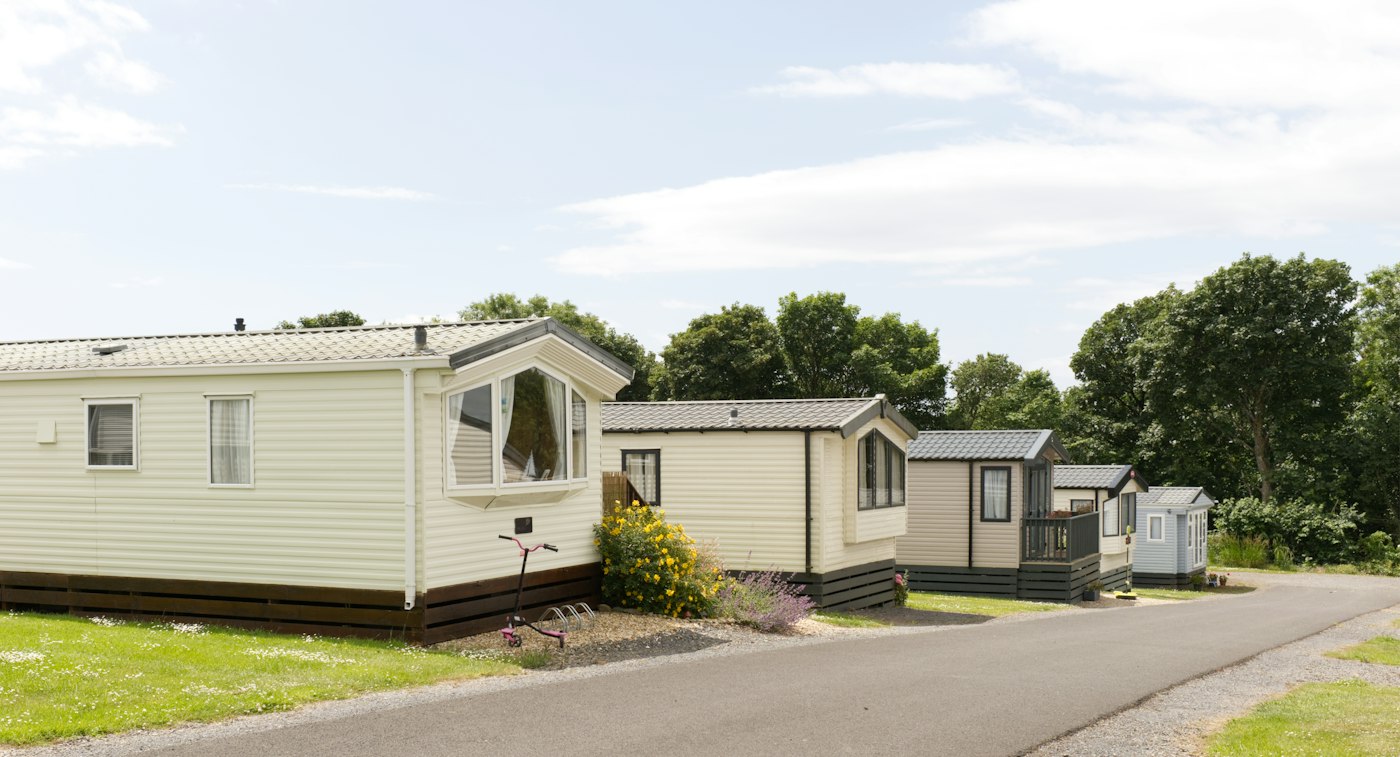
Photo: Kevin Dowling / Unsplash
What Washington did this summer, and what it is still deciding
Before I get to the bill everyone keeps asking me about, I want to mention the one that actually passed, because almost nobody outside the industry noticed.
In July, the 21st Century ROAD to Housing Act became law. It passed the Senate 85 to 5 and the House 358 to 32, which in this Congress is about as close to unanimous as anything gets. It is the largest piece of federal housing legislation in decades, fifty six separate provisions aimed at one problem: we do not build enough homes, and the ones we do build cost too much.
Two pieces of it matter directly to families here. The first is manufactured housing. The law removes the old federal rule that every manufactured home had to be built on a permanent steel chassis, which added cost for no reason once the home was sitting on a foundation. That makes the most affordable homes in our county cheaper to build and easier to place on small lots. It also funds grants to repair and preserve manufactured home communities, and I have clients in those communities from Opal Cliffs to Moss Landing who have been waiting a long time for someone in Washington to notice them.
The second is small dollar mortgages. Banks have quietly stopped writing loans below a certain size because they are not profitable enough, which has been a real wall for anyone trying to buy a modest home. The law creates a pilot program to fix that.
The honest caveat is that a lot of this depends on HUD writing the rules and Congress funding it, so the effects arrive over years, not months. But for the first time in a long time, the federal government treated housing supply as the problem it is, and did it with both parties in the room. That is good for every family that has ever been priced out of the place they grew up.
And the one that has not passed: portable mortgages.
On August 3 a bill called the MOVE Act, formally H.R. 10028, was introduced by Representative Thomas Kean of New Jersey. It would require Fannie Mae and Freddie Mac to begin buying portable mortgages, letting a homeowner carry their existing rate, balance and term to a new property instead of surrendering a good rate to move. A second bill from March, the Take Your Rate Act, would simply order a federal study on whether portability is workable.
Neither is law. The MOVE Act was referred to the House Financial Services Committee and has not passed the House, has not passed the Senate, and has not been signed. No lender can offer you a portable conventional mortgage today.
Will it pass? I would not build a plan around it. Most bills die in committee, this one is two pages long, and this Congress ends in January. But the ROAD Act just proved that housing legislation with broad support can get through, so I am watching it. I am just not waiting on it, and neither should you.
Where to start
If I had to pick three from this list for most families here, it would be these. Call your lender and ask about recasting and whether your mortgage insurance can come off. Pull your property assessment and read it line by line. And if you are over 55 and have been feeling trapped, go look up Prop 19 today.
I am a REALTOR, not a lender, an insurance broker or a tax professional, so please take each of these to the right person. But take them now, while you have room to plan, instead of the month it lands.
And if you want help figuring out which of these apply to your situation, that is exactly the kind of conversation I love. Just ask.
Más en Home Finance & Mortgages

6 Strategies to Save on Home Insurance Premiums
Home insurance premiums have been rising sharply, in some markets by 20 to 30% or more in a single year. Here are six strategies to keep your costs under…
8 Strategies to Secure a Lower Mortgage Rate
With mortgage rates at multi-year highs, getting the best possible rate on your home loan has never been more important. Here are 8 strategies that can lower your…

Hedge Against Inflation With These 3 Real Estate Investment Types
Inflation is running at its highest levels in decades, and investors are scrambling to protect their wealth. Historically, real estate has been one of the most reliable inflation…